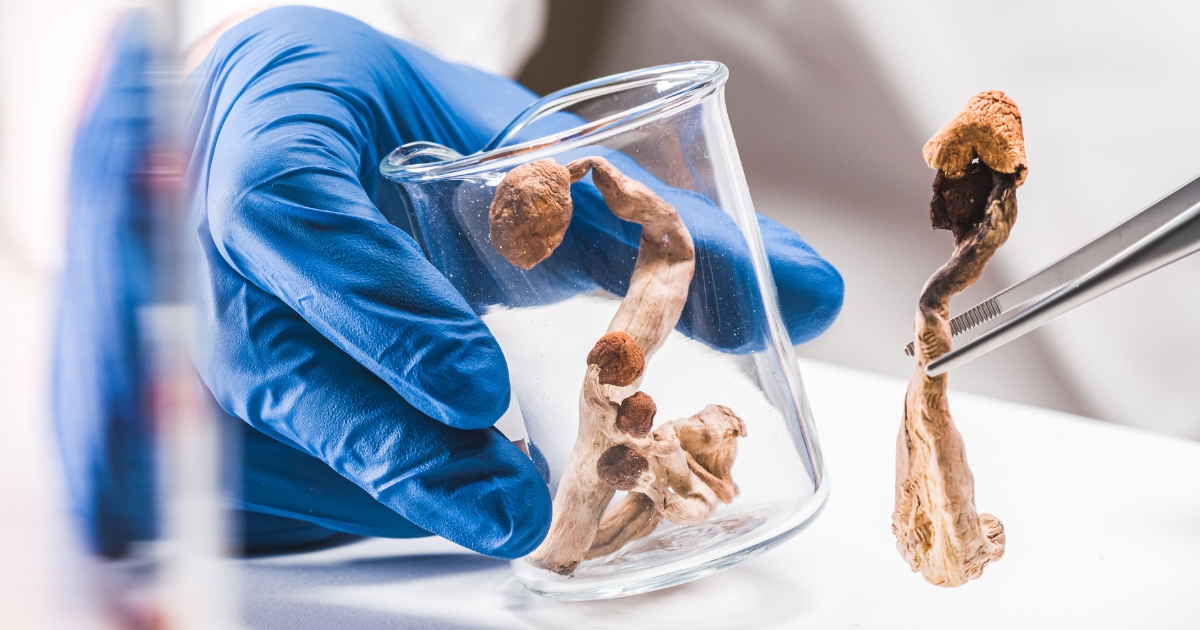
Key Psychoactive Compounds in Psychedelic Mushrooms
Psychedelic mushrooms contain a group of naturally occurring tryptamine compounds. The most important are psilocybin and psilocin, but other related compounds such as baeocystin, norbaeocystin, and aeruginascin may also occur in some species.
Understanding these compounds helps explain why different mushroom species and varieties can differ in potency, onset, subjective effects, and chemical profile.
Psilocybin
Psilocybin is the best-known compound in psychedelic mushrooms. Chemically, it is a phosphorylated tryptamine. In the body, psilocybin is converted into psilocin, which is primarily responsible for the psychedelic effects. Phosphorylated describes a molecule that has had a phosphate group attached to it.
Psilocybin is often described as a prodrug, meaning it becomes pharmacologically active after being metabolized into another compound.
Psilocin
Psilocin is the active metabolite of psilocybin. It interacts with serotonin receptors in the brain, especially the 5-HT2A receptor. This receptor is strongly associated with the effects of classical psychedelics, including changes in perception, cognition, emotional processing, and sense of self.
Psilocin is less chemically stable than psilocybin, which matters for storage, degradation, and laboratory analysis.
Baeocystin
Baeocystin is a naturally occurring psilocybin-related tryptamine found in some psychedelic mushrooms. It is chemically similar to psilocybin but differs in methylation.
Its role in the overall psychedelic experience is not fully understood. Some researchers and enthusiasts speculate that minor alkaloids may influence subjective effects, but strong clinical evidence is still limited.
Norbaeocystin
Norbaeocystin is another related compound found in some psilocybin-containing mushrooms. Like baeocystin, it is part of the broader tryptamine profile that may vary between species and samples.
Aeruginascin
Aeruginascin has been reported in Inocybe aeruginascens and is structurally related to psilocybin-type tryptamines. It is less widely studied than psilocybin and psilocin, but it is scientifically interesting because it may contribute to the chemical diversity of psychoactive fungi.
Why Chemical Testing Matters
The presence of a strain name does not reliably determine chemical potency. Laboratory methods such as liquid chromatography–tandem mass spectrometry, or LC-MS/MS, are used to quantify compounds like psilocybin and psilocin. This kind of testing is important because two mushrooms with the same strain name may not contain the same concentration of active compounds.
The “Entourage” Question
Some people suggest that multiple mushroom compounds may work together to shape the subjective experience. This is sometimes compared to the “entourage effect” discussed in cannabis. However, the mushroom version of this idea is still not fully established.
A cautious scientific statement is: psychedelic mushrooms contain multiple bioactive compounds, but psilocybin and psilocin remain the best-studied and most clearly linked to psychedelic effects.
Comments are closed