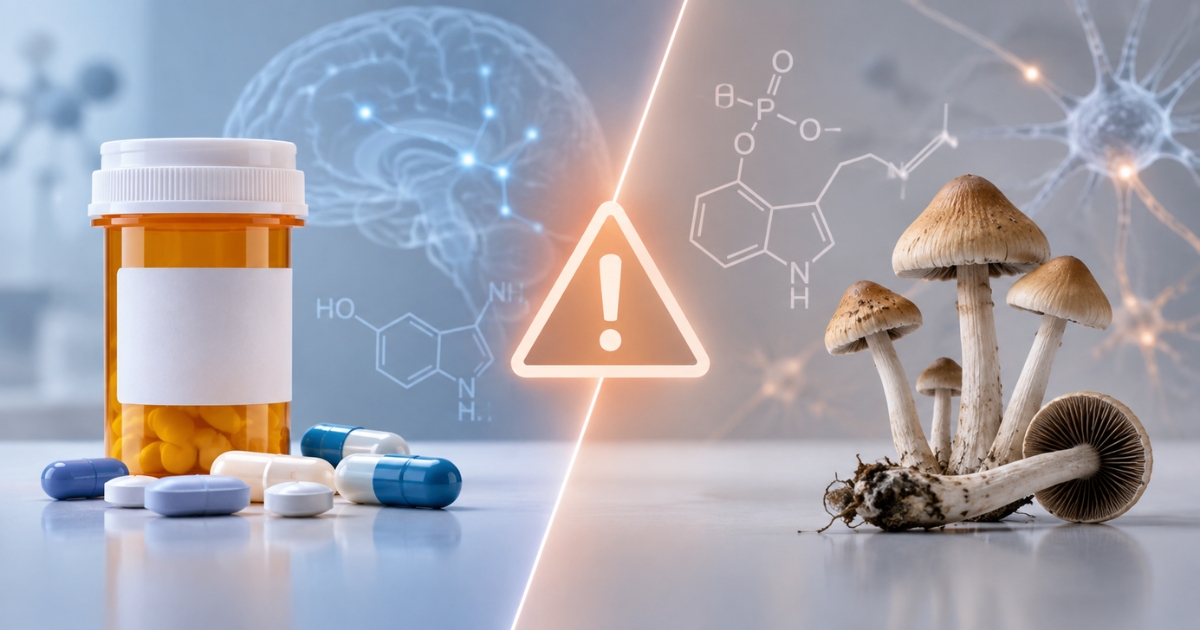
Psilocybin has attracted considerable scientific interest for its potential effects on depression, anxiety and other psychiatric conditions. However, people who take antidepressants, particularly selective serotonin reuptake inhibitors (SSRIs) or serotonin-norepinephrine reuptake inhibitors (SNRIs), should not experiment with psilocybin without medical supervision.
The main reason is not that the combination has been conclusively proven to be dangerous in every case. Rather, the interaction is still insufficiently understood, the psychedelic response may be substantially altered, and changing or discontinuing antidepressant treatment in order to take psilocybin can itself create important medical risks.
Psilocybin and antidepressants affect the same neurotransmitter system
Psilocybin is rapidly converted in the body to psilocin, which produces its psychedelic effects primarily through activation of serotonin receptors, particularly the 5-HT2A receptor.
- SSRIs (Selective Serotonin Reuptake Inhibitors): These block the reabsorption of serotonin in the brain, leaving more available to improve mood. They target serotonin exclusively. Examples include fluoxetine and sertraline.
- SNRIs (Serotonin-Norepinephrine Reuptake Inhibitors): These block the reabsorption of both serotonin and norepinephrine (noradrenaline). Examples include venlafaxine and duloxetine.
- MAOIs (Monoamine Oxidase Inhibitors): These stop an enzyme called monoamine oxidase from breaking down serotonin, norepinephrine, and dopamine. This increases the total supply of all three neurotransmitters. Examples include phenelzine and tranylcypromine.
SSRIs, including drugs such as:
- sertraline
- escitalopram
- citalopram
- fluoxetine
- paroxetine
SNRIs, such as:
- venlafaxine
- desvenlafaxine
- duloxetine
MAOIs, such as:
- phenelzine
- tranylcypromine
- isocarboxazid
- selegiline
Consequently, psilocybin and these antidepressants interact with overlapping serotonergic pathways. Exactly how these systems interact during psychedelic administration remains an active area of research.
SSRIs and SNRIs may substantially weaken the effects of psilocybin
One of the clearest findings so far is that long-term treatment with serotonergic antidepressants may reduce the subjective effects of psilocybin.
A retrospective study involving hundreds of reports found that psilocybin mushrooms were perceived as producing weaker-than-expected effects in approximately 47% of reports involving SSRIs and 55% involving SNRIs.
One possible biological explanation is adaptation of the serotonin system during chronic antidepressant treatment. Long-term increases in serotonergic signalling can alter the sensitivity or availability of serotonin receptors, including the 5-HT2A receptor that is central to the psychedelic effects of psilocin.
This creates an important practical problem.
Someone taking an SSRI or SNRI might experience little effect from a dose of psilocybin and conclude that they need substantially more. Increasing the dose in an attempt to overcome the apparent blunting could make the response more difficult to predict. Reduced psychedelic intensity therefore should not be interpreted as evidence that combining the substances is safe.
The interaction is still inadequately studied
Historically, many clinical psilocybin trials excluded participants taking serotonergic antidepressants or required them to discontinue their medication before receiving psilocybin. The reason was partly concern about pharmacological interactions and partly the absence of adequate safety data. As a result, we have much less controlled clinical data about people taking psilocybin while simultaneously taking SSRIs or SNRIs than we would ideally want.
More recent research is beginning to change this picture. A 2025 scoping review of 18 studies found that concomitant use of antidepressants and classic psychedelics appeared generally well tolerated, with no clear evidence of an increased incidence of serotonin syndrome with psilocybin. However, the authors also emphasised important gaps in the evidence and the need for larger controlled studies.
An open-label clinical study has also investigated psilocybin in people who continued taking an SSRI rather than withdrawing from it. Therefore, it would be inaccurate to claim that taking psilocybin with an SSRI automatically causes a dangerous serotonergic reaction. The more scientifically defensible conclusion is:
We do not yet have sufficiently strong evidence to consider unsupervised co-administration predictable or established as safe.
What about serotonin syndrome?
Both antidepressants and psilocybin affect serotonin, so serotonin toxicity has historically been raised as a theoretical concern. Serotonin syndrome is a potentially serious condition caused by excessive serotonergic activity. Symptoms may include:
- agitation or confusion
- tremor
- excessive sweating
- diarrhoea
- rapid heart rate
- increased body temperature
- muscle rigidity
- hyperreflexia or clonus
However, the risk needs to be described accurately. Current clinical evidence does not demonstrate that serotonin syndrome commonly occurs when psilocybin is combined with an SSRI or SNRI. A 2025 review found no clear increased signal for serotonin syndrome, particularly with psilocybin.
There have nevertheless been anecdotal and observational reports of symptoms potentially consistent with serotonin toxicity. For example, an analysis of 443 online reports of combined SSRI and psilocybin mushroom use identified 13 reports that the investigators considered potentially consistent with serotonin toxicity, although such uncontrolled reports cannot establish diagnosis or causality.
The risk is substantially different with some other serotonergic medications, particularly monoamine oxidase inhibitors (MAOIs), where psychedelic drug interactions may be considerably more medically concerning. MAOIs are more concerning because they inhibit the breakdown of monoamine neurotransmitters, including serotonin, which can substantially amplify serotonergic signalling. When combined with serotonergic psychoactive substances, this can make effects less predictable and may increase the risk of serious adverse reactions, including excessive autonomic stimulation and serotonin toxicity. For this reason, MAOI–psychedelic combinations generally warrant a higher level of caution than combinations involving standard SSRIs or SNRIs.
Psychological responses may also become less predictable
The issue is not limited to pharmacological toxicity. Psilocybin can temporarily produce profound alterations in:
- perception
- emotion
- cognition
- sense of self
- memory
- anxiety
- autonomic arousal
A psychedelic experience can occasionally involve severe anxiety, panic, confusion or psychological destabilisation. This is particularly relevant because people taking SSRIs or SNRIs are often being treated for depression, anxiety or another psychiatric condition.
Clinical psychedelic studies therefore do much more than simply administer psilocybin. Participants are normally screened for psychiatric and medical contraindications and receive structured preparation, monitoring and psychological support. People with certain psychiatric histories, particularly psychotic disorders or bipolar-spectrum conditions, have frequently been excluded from clinical psilocybin studies because of concerns about psychiatric destabilisation.
Stopping an SSRI or SNRI yourself can be a greater problem
A particularly important mistake is to hear that antidepressants may interfere with psilocybin and simply stop taking the antidepressant. SSRIs and SNRIs should not be abruptly discontinued simply to take psilocybin. Stopping serotonergic antidepressants can produce antidepressant discontinuation syndrome, which may include:
- dizziness
- nausea
- insomnia
- anxiety
- irritability
- flu-like sensations
- unusual sensory disturbances or “brain zaps”
- emotional instability
There is also a possibility that the psychiatric condition being treated may worsen or recur. SNRIs such as venlafaxine can be particularly difficult to discontinue rapidly because of their relatively short half-lives and pronounced withdrawal symptoms in some individuals. In clinical psychedelic research, when antidepressant discontinuation has been required, it has generally been performed gradually and under medical supervision, rather than by abruptly stopping treatment. One research protocol, for example, used approximately 2–4 weeks of tapering followed by a drug-free washout period. The appropriate taper is highly individual and depends on the medication, dose, duration of treatment and patient.
Simply waiting a few days may not solve the interaction
Another misconception is that stopping an SSRI for several days necessarily restores a normal psychedelic response. Research suggests the situation may be considerably more complicated. A survey study found reports of attenuated psilocybin effects even after antidepressants had been discontinued. The researchers found that reduced effects could persist for weeks or potentially months in some individuals. This makes biological sense because long-term antidepressant treatment can create adaptive changes in serotonin signalling that do not necessarily disappear as soon as the medication leaves the bloodstream. Fluoxetine presents an additional complication because both fluoxetine and its active metabolite have particularly long half-lives. For this reason, some clinical psychedelic protocols have used substantially longer withdrawal periods for fluoxetine than for shorter-acting SSRIs.
There is an important difference between clinical psilocybin and self-experimentation
When psilocybin is investigated clinically, researchers typically control or assess:
- the exact dose of psilocybin
- medication interactions
- cardiovascular health
- psychiatric history
- bipolar or psychosis risk
- other drug use
- treatment setting
- psychological preparation
- monitoring during the experience
- follow-up after treatment
Using psychedelic mushrooms independently provides none of these controls. Mushrooms also contain variable concentrations of psilocybin, making the actual dose considerably less predictable than pharmaceutical-grade psilocybin used in clinical trials.
The bottom line
People taking an SSRI, SNRI or MAOI should not discontinue their medication or experiment with psilocybin without discussing it with an appropriately qualified healthcare professional.
The main concerns are:
- SSRIs and SNRIs may significantly attenuate the psychedelic effects of psilocybin, while MAOIs may alter, intensify, or prolong its effects in less predictable ways.
- The safety and pharmacological interaction of simultaneous use remain incompletely understood.
- Trying to compensate for reduced effects by taking more psilocybin could create an unpredictable response.
- Psychological reactions to psilocybin can be intense and are particularly relevant in people already being treated for psychiatric conditiXXons.
- Abruptly stopping an antidepressant can produce significant withdrawal symptoms and potentially worsen the underlying condition.
- Stopping the medication for a short period does not necessarily eliminate the interaction.
At the same time, current evidence does not justify the simplistic claim that psilocybin plus an SSRI or SNRI inevitably causes serotonin syndrome. Emerging clinical evidence suggests that the combination may be tolerable under carefully controlled circumstances, but the evidence base remains limited.
The safest principle is therefore not
“stop your antidepressant before taking psilocybin.”
It is:
Do not alter antidepressant treatment or combine it with psilocybin without appropriate medical assessment and supervision.
Comments are closed